

"Yes tech; that's the thing"
On the timelessness of Wallace and Gromit

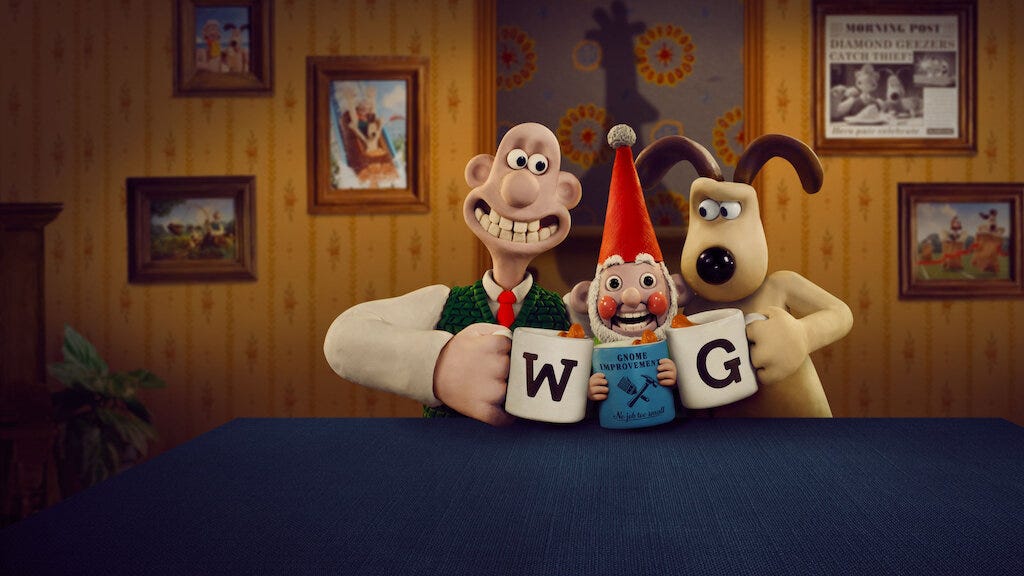
Every day is full of increasingly terrifying news. The wealthy are in power. Vital public goods are being eradicated. Tech billionaires are increasingly unregulated and running rampant. The future is unrelentingly terrifying. But, at 62 Wallaby Way in the north of England, the story is much different. There lives a man who believes the future is not terrifying, but exciting and full of possibilities; that we are always on the precipice of the next great invention. This is the home of Wallace and Gromit, the claymation inventor and his silent, sophisticated dog. For nearly four decades now, they’ve been toiling away on new projects that seem to, regardless of era, acutely reflect the complicated feelings that come with technological “progress”.
In 2024, Wallace and Gromit returned (this time on Netflix) for their first full length feature since 2005 and their first adventure of any length since 2008. The new film, A Vengeance Most Fowl, is the narrative successor to 1993’s The Wrong Trousers (the zenith of Wallace and Gromit films). In The Wrong Trouser, it’s Gromit’s birthday, and as a “gift” Wallace invents self-walking trousers for Gromit to take himself on walks. Without a sound uttered, we see and feel Gromit’s disappointment that Wallace doesn’t understand the joy that comes from their walks and has now invented them into extinction. In an effort to fend off towering bill payments that he’s fallen behind on due to his excessive spending on inventing, Wallace also rents out Gromit’s room. The lodger turns out to be the nefarious penguin named Feathers McGraw who ends up co-opting Wallace’s newly invented pants to help him steal the “famous” blue diamond and frame Wallace for the crime. In the end, Gromit saves the day by rewiring the trousers, wresting them from Feathers’ control, and capturing Feathers for his arrest.
The new film follows the same beats. This time, Wallace invents a robotic gardening gnome so that Gromit doesn’t have to do “all of those tedious gardening tasks”. Gromit is nonplussed — devastated that another one of his favorite hobbies is being usurped by the “progress” of technology. From prison (read: the zoo), Feathers is able to hack into the microchips that control the gnomes and use them to aid his own jailbreak. Tellingly, all Feathers has to do to gain control of the machine is change its setting from “good” to “evil”. The stakes are the same now as they were then for Wallace and Gromit. Feathers is once again after the “blue diamond”, and his primary tool is Wallace’s own over-reliance on technology. This is always the central conflict of Wallace and Gromit films. Wallace invents with abandon, Gromit and the rest of us are left with the consequences. The resolution comes from some necessary compromise.
The classic man and dog pair make for a neatly constructed allegory. Wallace is the foolhardy acceleration of human progress. Gromit — who is both comedically and poignantly always silent — is the unsuspecting natural world being dragged along into the chaos. Both films, like the rest of the W&G catalog, attempt to find the center of the tech debate through the pairs’ competing desires. They communicate the logical stance that technology is not inherently bad, but its consequences rely on our restraint and its morality lies in the hands of its user. While seemingly an obvious proposition, this new film comes at a time when an outsized amount of power is being concentrated into the hands of those at the forefront of tech and the regulation of new technology is seemingly on the chopping block, no doubt for their benefit.
In the post-industrial age, this has been endless debate. When is enough? What is too much? It’s the primary question of the Wallace and Gromit filmography and the key reason they have just as much to say about today as they did 30 years ago. In our own world, the stakes aren’t exactly the same, but certainly comparable to the world of 30 years ago. In 1993, the internet boom was in its infancy and the new technology of the digital age was creating new ways to communicate, entertain yourself, and relegate daily tasks. And things were changing quickly; five years prior, in 1988, only about 40,000 households worldwide had internet access. By 1993, that number had risen to over a million. The rapid development of new technology was changing the very nature of our social existence and there was both tremendous excitement and palpable fear and confusion in response. Sound familiar? The internet continues to change the way we experience and interact with the world — from our relationships with each other to our relationships with information — and today, AI technology is the latest frontier promising to wildly reshape the ensuing decades. In the new film, the robotic gnomes quickly turn off the television when a movie about robots taking over plays. The two main camps of thought – those in tech that fully embrace AI and those on the outside that are wary of its unknown capabilities – continue to be at odds. The machines have changed, the questions have not.
The same can not be said, however, in Wallace and Gromit’s fictional unnamed northern English town. Everything in the world of technology remains the same today as it was 30 years ago. Technological development seems to have stagnated in the world of Wallace and Gromit. The TVs resemble 1970s television models – small boxes with the dials on the front sides. The phones are mostly rotary home phones (not a cell phone in sight). And the computers are the original hefty beige boxes that can only muster up pixelated, glitchy webpages. This is some sort of fantasy, in which the progress of different technologies stopped right at the point they historically began to considerably diminish our relationship with the tangible world. And so, the plasticine citizens of this animated world still read physical newspapers, use analog alarm clocks, and shop exclusively at physical stores. In both narrative and setting, there is a balance between enthusiasm for the new, and a respect for the old ways.
Plasticine – the putty-like material that Wallace, Gromit, and the rest are made out of – is itself an argument in favor of old, practical, tactile modes of creation. While the world of animation is increasingly visually homogeneous from film to film and studio to studio1, Aardman, the production team behind Wallace and Gromit, are stubbornly committed to the most strenuous, time-consuming, and tedious style of animation. The marks of the animator's labor are visibly present on the characters in some shots of the films. You can clearly see fingerprints on characters’ bodies in close up shots. From the opening shot of any Aardman feature, it’s clear that there is a reverence for the old ways. But this too must give way to new technology. In A Vengeance Most Fowl, there are moments in which, for the first time in W&G history, computer animation is employed. It is a bit jarring when it happens, because it is notably out of place; but these moments of computer-aided animation concede to the Wallace side of the debate that technology does have its benefits and is unavoidable in the modern world. Aardman have considered the question of technology enough to know it is equally as foolish to ignore new tech as it is to unquestioningly embrace it.
These factors together – the dynamic between Wallace and Gromit, the antiquated world they live in, and the material they are made out of – both differentiate Aardman’s W&G adventures from other modern animation and refine the central ideas of the films themselves. By inviting us into this fantasy world, Aardman inherently makes the case for the pleasures of the old world and its dated technology. It’s a case reflected further in the disparate personalities of the characters. While Wallace lives in the aforementioned world of anachronisms, his obsession with inventing sees him constantly rejecting it in favor of what he sees as unbridled progress (“Yes, tech; that’s the thing!” he proudly proclaims to Gromit in the new film). In the asides we get of Gromit, we see the poor pooch desperately trying to escape into the joys of the old modes of mental and personal enrichment. One of the recurring gags of Wallace and Gromit are the pun-filled titles of the high-brow art he’s reading and listening to. In The Wrong Trousers he sits at the breakfast table reading The Republic by Pluto; in A Vengeance Most Fowl he sits in bed reading A Room of One’s Own by Virginia “Woof”2. He’s been shown to have albums by Bark (Bach) and Poochini (Puccini) in his classical music collection. These are just Easter eggs, yes, and good enough to get a chuckle. But we routinely see Gromit frustratedly putting his book down, distracted by the inventions Wallace has foisted upon him. Like most universities, the assumed prevalence of the STEM fields has pushed the humanities to the side.
In these moments, we are undoubtedly meant to be more sympathetic toward Gromit who, as a dog, is ironically far more in touch with his humanity than Wallace. It hurts the heart to see Wallace so flippantly cast aside the simple pleasures Gromit clings to in favor of technology. We automatically recognize the value of the things Wallace eschews and Gromit yearns for every time we see them being replaced. This almost always leads to some cathartic payoff. In A Vengeance Most Fowl, Gromit looks longingly at the old teapot he and Wallace used to use — now relegated to collecting dust in the decades since Wallace invented a machine to make tea for them. Later in the film, there is a gag in which Wallace is unable to remember how to use the simple teapot since it has been so long and he decides it is “broken”. In the film’s twist, we learn that Feathers McGraw actually hid the diamond in the unused teapot before being escorted away by the police all those years ago. Wallace’s blind dependence on technology has in effect allowed him to be set up. It’s another reminder that the more we cede to technology the more we cede to those that control it. The results inevitably leave us playing the part of the fool.
As always, there is a moment of clarity that allows Wallace and Gromit to overcome the unforeseen consequences of new technology. The two team up to one by one reprogram the robot gnomes back to the side of good and, in the end, are able to once again foil Feathers McGraw’s plot. After being helped, then saved by the robot gnomes, Gromit gives one a hug prompting Wallace to exclaim “I knew you’d embrace technology!” As always, no matter how many times the lesson must be learned, Wallace can only see the good of technology and ignore the vitally important context surrounding it. As such, I’m sure there will be more trouble for the duo to get into and more Wallace and Gromit films to come. When they do, their world will certainly look even more different from ours. We can only hope that we have learned our lessons a bit quicker than Wallace.
Disney has not released a 2D animated feature since 2011; Dreamworks’ last non-computer animated feature was, in fact, Wallace and Gromit: The Curse of the Were-Rabbit in 2005 — a co-production with Aardman.
Another favorite from 1995’s A Close Shave is “Crime and Punishment by Fido Dogstoevsky”